
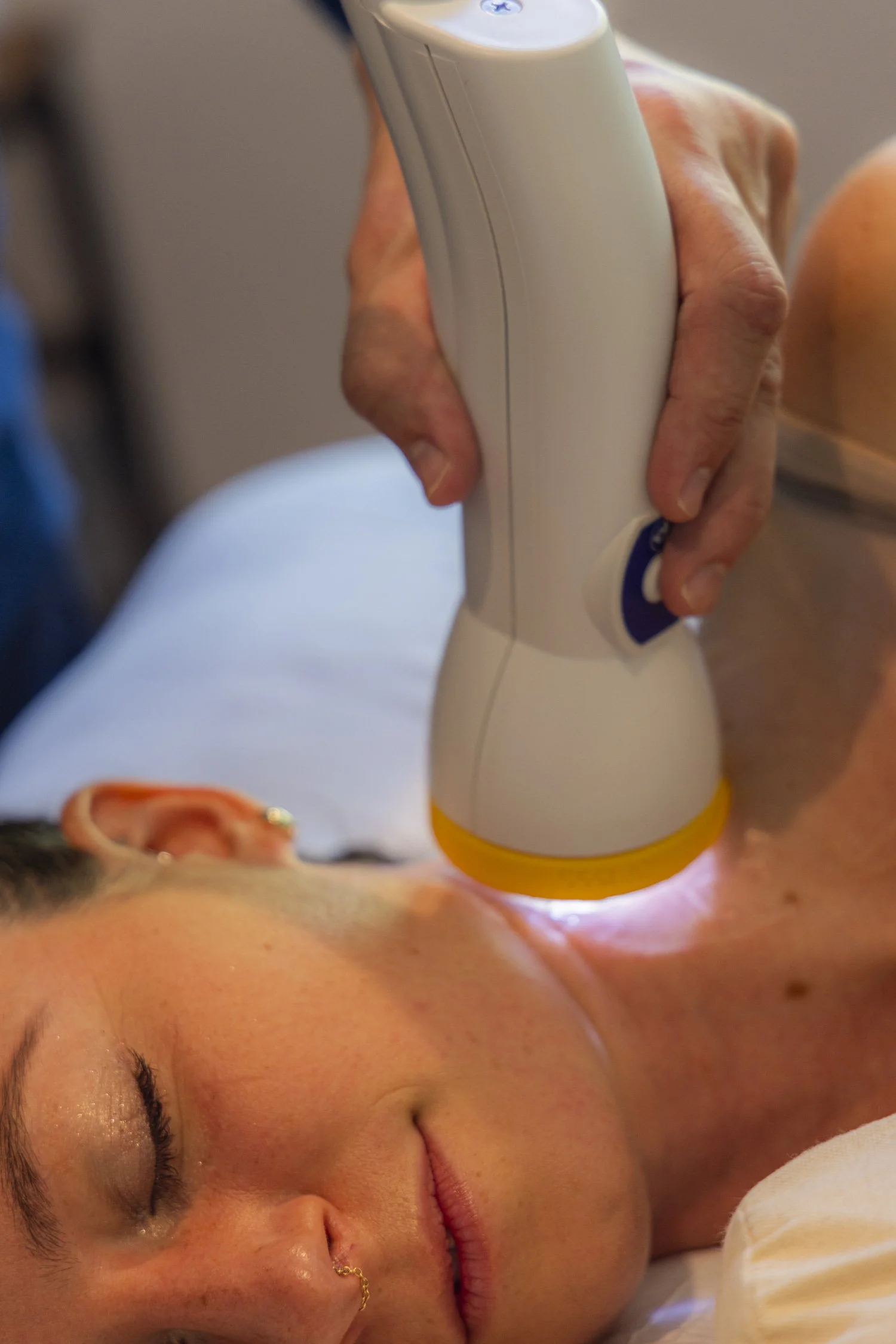
What is SoftWave Therapy?
SoftWave is a non-invasive form of extracorporeal shockwave therapy. It uses an electrohydraulic source to create acoustic pressure waves, which are delivered through the skin to the treatment area.
The goal is not to numb the area or cover up the signal of pain. The waves are used to create a mechanical stimulus that may support circulation, connective-tissue activity, and the body’s own repair response. SoftWave’s broad-focused design allows treatment to cover both deeper and more superficial tissue rather than concentrating on one small point.
At Biohacker Rehab, SoftWave is usually one part of a larger plan. We also look at how you move, what loads the area, what has already been tried, and what your body needs in order to keep the progress going.
What Benefits Can SoftWave Offer?
The main reason people seek out SoftWave is persistent pain that has not responded well to the usual options. Depending on the condition, treatment may help reduce pain sensitivity, support local circulation, and improve the tissue’s ability to tolerate movement and load.
SoftWave is also attractive because it does not require an injection, anesthesia, or a surgical procedure. Active treatment typically takes 5–10 minutes, and most people can return to normal activity afterward. Mild soreness or sensitivity can occur, similar to the feeling after a workout.
The benefits are usually more meaningful when SoftWave is paired with the right rehabilitation. Less pain is helpful. Better strength, movement, and confidence in the body are what allow that improvement to last.
- Non-invasive treatment with no needles or incisions
- A short session that can fit into a broader rehabilitation plan
- May support connective-tissue activity and local blood flow
- May reduce pain and sensitivity in some chronic or overuse conditions
- Can be combined with manual therapy, exercise, and movement education
Who May Be a Good Candidate?
SoftWave may be worth considering when pain has lingered, progress has stalled, or the area is not tolerating the demands you need to place on it. It can be especially useful when the problem appears to involve tendons, ligaments, fascia, muscle, scar tissue, or other connective tissue.
People often come to us with plantar heel pain, tennis elbow, Achilles or patellar tendon pain, shoulder and knee problems, overuse injuries, or pain that has made it difficult to return to work, training, or everyday activity.
You do not need to be an athlete, and you do not need to have tried every treatment already. A good candidate is someone whose condition has been properly assessed and whose treatment plan can include more than a passive session on a table.
- Pain that has lasted longer than expected
- Tendon, ligament, fascia, or other soft-tissue concerns
- An overuse injury or a gradual loss of movement capacity
- Persistent pain after an initial course of rehabilitation
- A desire to avoid or delay more invasive options when clinically appropriate
- Someone who is ready to participate in progressive recovery, not just chase temporary relief
Who Is SoftWave Not For?
SoftWave is not a substitute for a diagnosis. If your pain is new, severe, unexplained, or getting worse quickly, the first step should be a proper medical evaluation. Before treating the pain, we need to know what we are treating.
Treatment may also need to be postponed or avoided when there is an active infection in the area, an untreated fracture, a suspected blood clot, or a condition that requires urgent care. Certain medical conditions, medications, recent procedures, and areas of the body may require additional precautions.
Pregnancy, active cancer in or near the treatment area, significant bleeding or clotting problems, and implanted devices are all reasons to speak with your physician and the treating provider before scheduling. The answer depends on the location, the device settings, and your overall medical history—it should not be decided from a checklist alone.
- People who have not yet had an appropriate assessment
- Anyone with severe or rapidly worsening symptoms that need urgent evaluation
- An active infection, untreated fracture, or suspected blood clot near the treatment area
- People who are pregnant or have complex medical conditions without clearance from their medical team
- Anyone expecting one treatment to replace strengthening, movement changes, or an appropriate medical plan
What SoftWave Is—and What It Isn’t
SoftWave is FDA-cleared for specific uses, including temporary relief of minor muscle aches and pains, temporary increases in local blood circulation, activation of connective tissue, chronic diabetic foot ulcers, and superficial partial-thickness second-degree burns. Those clearances do not mean that every condition listed on a clinic website is an FDA-cleared indication.
In musculoskeletal care, providers may use SoftWave as part of an individualized treatment plan for concerns such as tendinopathy, plantar heel pain, and overuse injuries. The evidence for shockwave therapy varies by condition, and results vary from person to person. A consultation should include an honest discussion about what the treatment is expected to do—and what it cannot do.
SoftWave is not a magic reset. It does not repair every injury, remove the need for exercise, or guarantee a particular outcome. It is one tool. The value comes from using it in the right situation and following it with a plan that helps the body adapt.
What Treatment Feels Like
Your first visit begins with an assessment of your symptoms, movement patterns, history, and goals. Once the treatment area is identified, the device is applied to the skin with a coupling gel.
Most people describe a deep tapping, pressure, or pulsing sensation. The intensity can be adjusted throughout the session, and your feedback matters. Active treatment generally takes 5–10 minutes, although the full visit may include assessment, manual work, or movement guidance.
You can usually walk out and continue normal activity. Some people feel better quickly, while others notice changes gradually over several sessions. Tissue remodeling and improved load tolerance can take weeks, so the first change is not always the final result.
The Biohacker Rehab Approach
We do not use SoftWave as a standalone answer to every problem. We use it when the assessment suggests that the tissue and the nervous system may benefit from that stimulus, and when it fits the person in front of us.
That may mean combining SoftWave with manual therapy to address restrictions, progressive strengthening to rebuild capacity, movement education to reduce repeated strain, or changes to training and daily activity. The plan changes as you change.
The purpose is not simply to get you through a treatment session. It is to help you move with less fear, more capacity, and a clearer understanding of what your body needs next.
The Bottom Line
SoftWave may be a good fit for persistent musculoskeletal pain, slow-to-heal soft-tissue problems, and people who need another option beyond rest, medication, or injections. It is quick, non-invasive, and can support a broader rehabilitation plan.
It is not right for every person or every condition. The best first step is an assessment that considers the diagnosis, the treatment area, your medical history, and what you are trying to return to.
If your recovery has stalled and you want to understand whether SoftWave makes sense for you, schedule an introductory session at Biohacker Rehab in Encino, CA. We will start with the full picture—not just the painful spot.